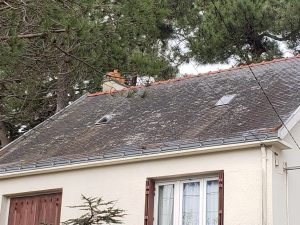
How to repair a roof? Repairing a roof may seem difficult, but it can be done with a method. Before you start, make sure you take the necessary precautions for working at height. Whether you need to fix leaks or change tiles, you can easily complete the task by following our tips.
Inspect your roof
It is essential to locate and identify the problem before repairing your roof. It’s not always obvious where the damage is coming from, especially when it’s water leakage. Before considering any repairs, take the time to determine exactly where the problem is coming from. To do this, check the condition of your roof from the outside as well as from the attic.
Use the right products to repair your roof
Your roofing problem may be simple to fix. A shingle is curled? Put it back in place using roofing glue applied with a brush or spatula. This product can also be used to seal small cracks. If there is a hole in a masonry flashing, use roofing mortar or putty to fill it.
Replace damaged tiles or defective panels
If you find damaged tiles or cladding panels, do not hesitate to replace them. Otherwise, water could seep in and cause major damage. To repair your roof, start with the top row if there are several rows. If the roofing material is new, this should not be a problem. If your roof is old, however, you will need to obtain salvaged material similar to your roofing. However, there are some very convincing imitations on the market today. You will therefore have no trouble finding what you need. In any case, be careful not to damage your neighbors when removing the damaged parts.
How do I repair a broken tile?
Although clay tiles are the most weatherproof material for your roof, roof tiles are still exposed.
Once a tile is cracked or broken, it is invaded by moss and vegetation. Broken tiles eventually come loose and slide off before either blocking the gutter or risking falling to the ground onto your car or your head!
After a storm or at the end of winter, if you are not sure of the condition of your roof, make an annual inspection: either by climbing on the roof, or from the outside with binoculars, or from the inside through the under-roof.
If necessary, don’t hesitate to call in a roofer for annual maintenance.
And in any case, if you find tile splinters on the ground: there is no doubt that your roof has been damaged!
What causes the tile to break?
Climate, rainfall, temperature changes, UV, accidents (falling branches or roof elements, storms…): at some point, some tiles are damaged.
Protect your roof tiles: prune
During strong gusts of wind or storms such as we sometimes experience, large tree branches fly off and hit the roof.
The best precaution to take to limit the risks is therefore to prune as much as possible the trees around your house. Any branch that could become a potential threat to your roof by breaking off should be pruned.
The importance of repairing broken tiles
It is important in many ways not to leave a broken tile lying around.
A single broken tile leaks: the infiltration of rain and moisture will create a waterproofing defect in your roof, and jeopardize your frame and lead to problems of moisture and mould in your insulation or walls. Multiply this phenomenon by 10, 20 or 50 cracked or damaged tiles and you will understand why it is urgent to seal a leaky tile roof.
A loose tile that slips and falls can damage your plants, your property (garden furniture, glass roof, car…) and people.
A slipping tile can carry other tiles in its fall and damage your gutters and gutters, or even block your rainwater drains.
Cracked tiles are more susceptible to fungus, mould, lichen, etc.
Birds, rodents and bats, but also wasps or hornets, can sneak under your roof through the opening created by a broken tile and create damage or install their nest in your insulation.
When to repair and when to replace?
If an examination of your roof reveals more than one damaged or dislodged tile, the question may arise as to whether to replace the roofing or to renovate the roof.
This depends on the age of your roof and the extent of the damage.
If you only have a handful of broken roof tiles, then it’s no problem to make minor repairs.
However, if the tiles have been left in this condition for a long time and damage to the underside of the roof is apparent, it may be time to remove the roof covering and re-insulate or waterproof your roof!
Inspect under the roof to see if the roof is still watertight.
If your roof is too badly damaged, you should remove it and re-seal and re-roof.
Don’t wait for the seepage to eat away at your insulation and walls.
Emergency tile repair
A few tiles have fallen off and you don’t have any replacement tiles on hand?
You will still need to protect your roof while you get new tiles!
With the usual precautions, while waiting for the roofer, fix a strong plastic sheet at the place of the damage, and secure it properly.
If your structure is damaged, do not climb onto your roof. Call in a professional roofer for your roof repairs.
When should you have your roof re-roofed?
Remember that replacing a tile or applying a sealant is a temporary solution to an imminent larger problem.
Unless there is a weather problem, broken tiles here and there can indicate that your roof is getting old and tired.
So one-off repairs will not prevent you from re-roofing in the short term…
if your roof is more than 20 years old
if you notice infiltration or insulation problems
if the waterproofing leaves something to be desired
if your roof has been poorly maintained and is covered with moss if the roof slopes are no longer flat and the rows no longer aligned… It’s time to re-roof!
How to repair a roof Reparation toiture Lorient
 Types Of Vacuum Cleaners : if you are planning to really clean your home, car, camper, or job site, you’ll want to check out one of the many types of vacuum cleaners. There are several out there, with each one offering you an array of special uses and features.
 L Europe attaque la Hongrie.
  Drones Big Data Armes automatisees . La vidéo virale et les armes automatisées. La vidéo Slaughterbots suscite un buzz impressionnant sur les réseaux sociaux, et beaucoup d’entre vous m’en ont parlé.